Water tank inspections can be cumbersome, time consuming and expensive, but remotely operatated vehicles (ROVs) are changing this.
Configure Now
Items in Your Cart0
0Items in Your Cart
Start building your packageShop Now
Water tank inspections can be cumbersome, time consuming and expensive, but remotely operatated vehicles (ROVs) are changing this.
Water tank inspections can be cumbersome, time consuming and expensive, but remotely operatated vehicles (ROVs) are changing this.
 During traditional water tank inspections, inspectors examine the tank for compliance with OSHA/American Water Works Association (AWWA) standards and guidelines. They examine coating condition; looking for cracking, peeling, delamination, blistering and rusting. This visual process often involves hiring an outside dive team to examine the inside of the tank or draining the tank completely to provide access.
“You often have to wait to get on divers’ schedules. Plus, hiring a dive team can be costly,” says Chris Wolfgram, SEH Protective Coatings Manager.
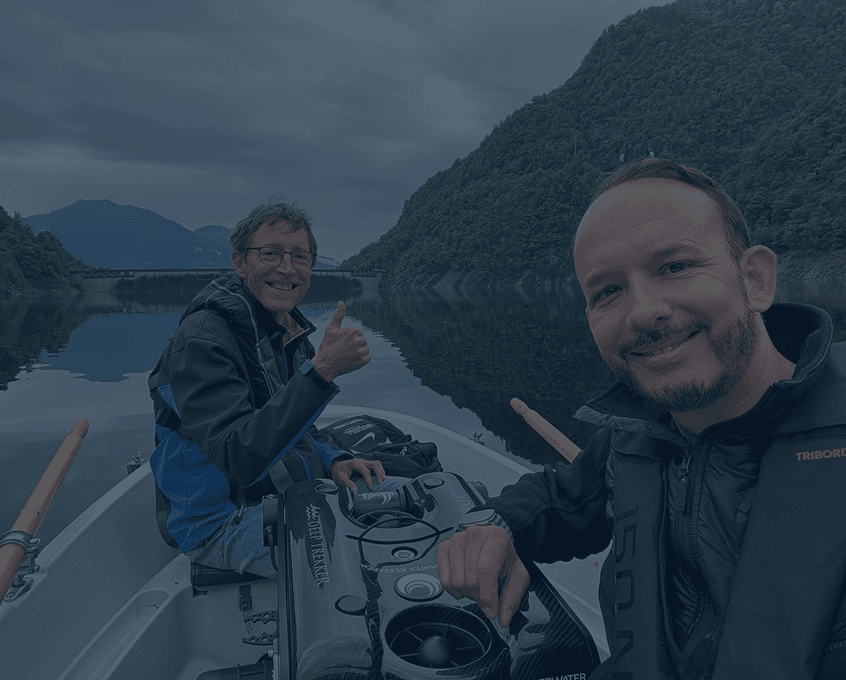
ROV technology is helping to streamline things. Completing water tank inspections requires a two-person team and one ROV. One person climbs the tank to insert the ROV into the bowl while another operates it from the ground using a remote-control panel. The ROV remains connected to the remote-control panel via a fiber optic cable. The ground operator sees what the ROV camera records on a display.
“We’ve had good success using the Deep Trekker ROV for our tank inspections,” says Chris Wolfgram. “They’re really portable and have several different options.”
In a typical drain down inspection, a water tank is taken out of service while the inspection team enters the bowl. This requires wasting water which would otherwise be used by local residents. It also requires providing residents an alternative means of water (continuous pumping or temporary water source), and requires the tank to be disinfected for AWWA compliance prior to returning to service. With an ROV, the water tank can remain in service.
Tank inspection with a dive crew often involves removing some of the water for sediment removal or complete water removal for a drain down inspection. Removing water is costly and time consuming. ROVs can operate inside a tank, regardless of how much or how little water is left in it.
As mentioned above, there is no need to hire a costly dive team, or remove tank water. On a typical elevated water storage tank evaluation, savings can be up to 50 percent when using an ROV instead of a dive team. When your consultant owns its own ROV equipment, the cost savings can be substantial.
For cities with multiple tanks, using an ROV creates the opportunity to inspect up to three tanks in one day. Using a dive team means only one inspection per day. In addition, waiting for dive team takes time, but so does waiting for their reports. A typical wait for reports once a dive team completes an inspection is up to 30 days. After that, the consultant combines its findings and the dive team report before submitting to a client. Using an ROV streamlines the reporting process as it’s done by one entity.
“With the ROV we can come in and do a complete inspection in a couple of hours,” says Josh Rettig, coatings inspector. “Before, the process would take nearly a full day. We can also turn around a report within a couple of days.”
A good consulting team operating an ROV is made up of NACE International (NACE) and American Welding Society (AWS) certified personnel trained in providing water tower inspection services.
Water tank inspections are a part of utility operations. Regularly scheduled inspections make sure the tanks are clean, operate correctly and a consistent schedule of inspections allows for easy, ongoing maintenance – a cost savings over time. The AWWA recommends an inspection every three to five years. Traditional visual inspections often involve the use of a separate dive team, which is costly and time consuming. Remote operating vehicles (ROVs) are helping to bridge that gap.
Learn more about other products we offer: DT640 Spotlight

March 17th, 2026
Two-day AIMS training program teaches SAR teams how to integrate sonar...
March 11th, 2026
Deep Trekker’s SPECTRA ROV integrates 3D Sonar SLAM, 4K stereo vision,...

November 3rd, 2025
At REPMUS 2025, Deep Trekker’s ROVs validated real-world mine countermeasure capabilities...