Configure Now
Items in Your Cart0
0Items in Your Cart
Start building your packageShop Now
Date: August 31 to September 25, 2026
Location: Tróia and Sesimbra, Setúbal Peninsula, Portugal
Organizers: Portuguese Navy, NATO, NATO Centre for Maritime Research and Experimentation (CMRE), Faculty of Engineering of the University of Porto (FEUP), NATO JCGMUS, and the European Defence Agency (EDA)
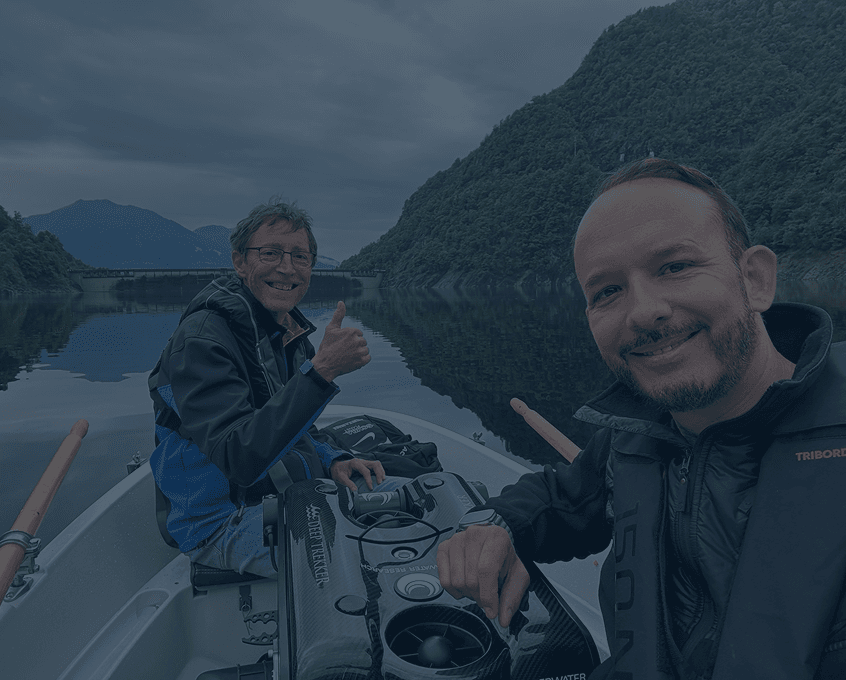
Deep Trekker team:
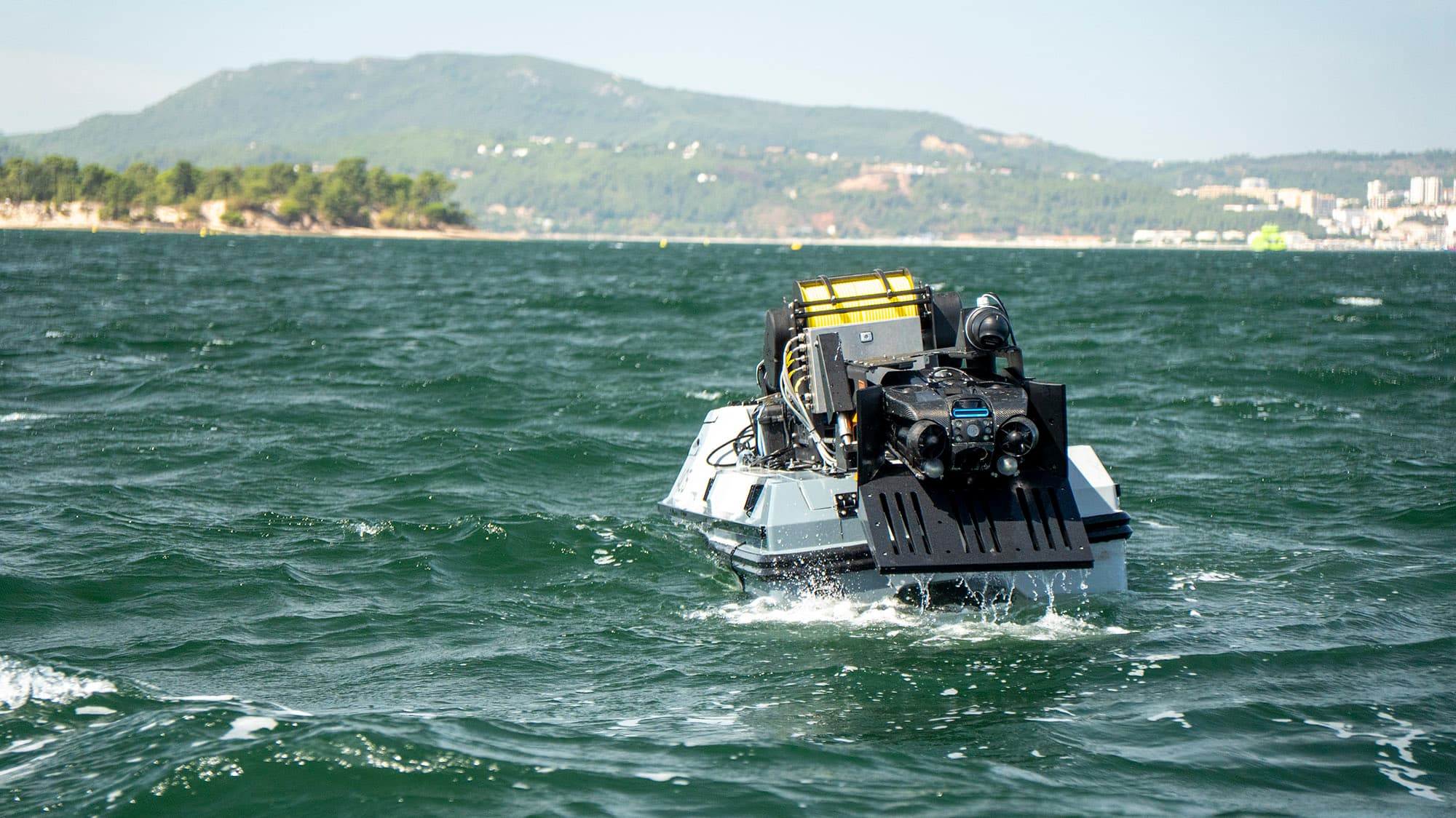
At REPMUS 2026, a REVOLUTION ROV deployed from an uncrewed surface vessel (USV) found and inspected an exercise mine with nobody on the water above it. It did so on the first day of testing, on the system's first mission.
REPMUS (Robotic Experimentation and Prototyping with Maritime Unmanned Systems) is where allied navies and industry test maritime robotics in real operating conditions. Our team spent almost 4 weeks in Portugal alongside mine countermeasure (MCM) and explosive ordnance disposal (EOD) units.
In 2025, we tested individual building blocks from a crewed RHIB. In 2026, we brought a working system: an ROV hosted on a USV, a full chain from detection to disposal, SPECTRA, and diver-controlled ROV operations with Blueprint Subsea.

REPMUS 2026 brought together 19 navies, and 13 of them deployed units in the water:
The Royal Navy, German Navy, Royal Danish Navy, Italian Navy, Royal Australian Navy, and Romanian Naval Forces attended with staff or observers.

Yes. On the first day of USV testing, a REVOLUTION deployed from an uncrewed vessel reacquired, inspected, and identified an exercise mine. The operator worked from a safe stand-off position, with sonar and UHD video from the seabed.
Three companies, two Swedish and one Canadian, made it work. Nautrik operated the USV, Lidan Marine handled deployment, recovery, and the tether with its SKARV launch and recovery system (LARS), and Deep Trekker piloted the REVOLUTION.
"The very first day, on the very first test, we were able not only to make the system work, but to go into the area, find the mine and inspect it," said Riccardo Caponi, Account Executive, Military Sales EU and Middle East at Deep Trekker.
In our REPMUS 2025 recap, Riccardo predicted that USVs would be the next tool to add to the mine countermeasures toolbox. Replacing the crewed boat that "ferries" the ROV to the target, he wrote, could decide whether a mission finishes or aborts in rough seas. REPMUS 2026 was the turning point:
"Last year it was a slide. This year it was a real mine on the screen, in a NATO exercise minefield, with nobody on the boat above it. The REVOLUTION left the SKARV mounted on the NAUTRIK, dived, reacquired the contact, and gave the operator a clear picture to make the identification. That was the moment the concept became a capability. What I appreciated most is that it worked as a system: three companies, two countries, one mission. That is exactly what navies are asking the industry for today."

In 2025 we field-tested individual capabilities from a crewed RHIB: ELWAVE passive electric-field detection, the Viper MDS integration on REVOLUTION and PIVOT, and Voyis stereo imaging. In 2026 the focus moved from components to an integrated, operational system. The ROV was hosted on an uncrewed surface vessel and identified a real exercise mine. We also demonstrated the complete mine countermeasures chain, from detection through disposal, alongside SPECTRA and diver-controlled ROV operations
Nautrik builds small, fast USVs for military end users. The compact, trailerable platform runs remotely over 5G and satellite connectivity.
Lidan Marine has built marine cranes and winches for over a century, launching and recovering work-class ROVs, AUVs, and towed sonar. SKARV is its system for observation-class vehicles, built from splash-proof aluminum and plastic with a driven, two-sided rubber tether feed. The garage tilts down to release the ROV, and the winch draws it back in on recovery.
The REVOLUTION carries out the subsea work: visual inspection, sonar search, positioning, and identification.
Before REPMUS, the three companies completed a live on-water trial of the full workflow. The REVOLUTION deployed from the garage, worked on the seafloor, and returned to the USV for recovery.
For positioning, the team fed the USV's GPS position into the REVOLUTION control interface. The operator drove the ROV under the USV, reset its position there, and navigated by dead reckoning. On site, the team also adapted the software to embed sonar data in the recorded video.

The SKARV handles the tether through deployment, operation, and recovery, and the system held up in sea state 2 to 3. Tether management was our biggest concern going in, with risks of entanglement and the USV drifting onto the ROV. In practice, it performed most consistently. Riccardo credits the SKARV:
"What made it easier than expected was the Lidan SKARV, a real piece of engineering artwork. Lidan has been building capstans for about a century; they know how to manage cables. Cable handling is a craft (in French we say un métier): you can't improvise it."
A USV and ROV system costs a fraction of a typical AUV and gives you identification in real time. AUVs can cost millions of dollars each, and analysts often need about 24 hours or more to review the sonar data they collect.
Even with synthetic aperture sonar and onboard target recognition, the output is often a small thumbnail of a possible mine. A crewed RHIB with an ROV still has to go out and confirm it. AUV sonar reaches further, about 60 to 100 m (197 to 328 ft), but the decision loop is far longer. Riccardo Caponi described the gap:
"At the end, the AUV, so intelligent and expensive, gives you like a 50 by 50 pixel image: this may or may not be a mine."
With a USV and ROV, the operator watches the seabed as the ROV searches, then flies closer to confirm a contact on UHD camera during the same mission:
"You can keep the system offshore for days. The operators work in shifts from shore, they look at the seabed in real time, and if they have a doubt they simply go closer and look with the camera."
A RHIB puts a boat driver, an ROV pilot, and a tether handler in or near the danger area, for missions of up to about 3 hours. A USV puts nobody on the water above the target, and the system is being developed to support longer missions with operators working in shifts ashore:
"It's like sending a small minehunter into your minefield: real time, and unmanned. If something goes wrong, you lose equipment, not people."
The same model applies to ports and harbours, offshore energy, and remote infrastructure, where vessel day rates, crew mobilization, and repeat inspections drive cost. For suitable missions, a remotely deployable ROV reduces the need to send a crewed vessel to the site.

Today, the operator works across separate control systems for the USV, the LARS, and the ROV. The development path brings them into one coordinated system, run from a single operator position. The trial also showed where the integration needs refinement:
Navy teams detect mines with sonar, then close in and identify them on camera. Alongside the USV trials, our team ran RHIB-based missions and the Deep Trekker Challenge, using exercise mines and mine-like objects (MLOs) positioned from AUV survey data.

The Deep Trekker Challenge returned in 2026 as a reacquisition and identification exercise for allied navy teams. The organizers knew the target positions, and the teams did not. A team that had not found its target by the end of its slot received the position and went straight to it.
In the area code-named Mike Whiskey Alpha, two RHIBs worked side by side, one crewed by Deep Trekker and one by the Belgian Navy. The first crew to find the mine won a round of drinks from the other.

Our team ran each mission the way our customers do, with a boat driver, a tether handler, and an ROV pilot on board. We also applied water space management, entering only our assigned sub-area because divers may be working in the others.
On one windy afternoon transit back from the southern area, Riccardo and Blake Hutchings were soaked on the RHIB and the controller took a large amount of water. It kept working, where a laptop would not have.

The REVOLUTION, fitted with a Blueprint Subsea Oculus M750d sonar, produced these lessons:
Navy teams running earlier-generation Deep Trekker systems with USBL positioning responded strongly to REVOLUTION's Dead Reckoning. You surface, take a GPS fix, dive, and navigate, with no USBL to deploy and calibrate. In shallow water, that saves precious time.
During REPMUS, our team also showed navy operators ROV features they had not used before. Our training courses cover the same ground for your team.

Yes. REVOLUTION supports detection, classification, identification, and disposal. For disposal, it carries three disruptors: the Viper MDS, the ADAPTOS TiTAN, and the Alford Vulcan.
REPMUS does not permit live firing, so the team brought Vulcan mock-ups, supplied by Alford, and the Viper MDS to show integration and handling. The Viper MDS was first integrated and field-tested on REVOLUTION at REPMUS 2025. Since then, TiTAN has been fired from REVOLUTION, and Vulcan has been fired during trials in Bristol.

Older mines carry about three sensors, while modern mines can carry 10 or more and target ships, divers, or ROVs. The environment adds more variables. REPMUS offered visibility above 10 m (33 ft) over sand, while MCM units usually work in zero visibility, strong current, and rocky ground.
No single system covers every case. Riccardo Caponi explained:
"The only way to cope with a constantly changing environment with a lot of variables is to have a lot of tools and use the right one adapted to the right situation."
No single system covers every case, so MCM teams rely on a toolbox and choose the right tool for each situation. Our disposal approach follows the same logic: ballast, mounting plates, and small accessories let you re-trim REVOLUTION for each disruptor and each site.
SPECTRA builds a live 3D picture of its surroundings with on-board 3D sonar SLAM, even in turbid or zero-visibility water. At REPMUS 2026, our team showcased SPECTRA in demonstrations from the pier.
SPECTRA pairs a factory-calibrated 4K stereo camera with 3D sonar SLAM processed on the vehicle's internal computer. Its seven-thruster symmetrical layout holds position in currents up to 2.3 knots with forward speed up to 3.5 knots.
In 2025, the Voyis stereo camera on REVOLUTION produced 3D datasets for photogrammetry and digital twins, but that approach depends on visibility and post-processing. SPECTRA processes stereo imaging and 3D SLAM in real time, without bulky topside computers.
For harbour and port security, you see the geometry of a hull, quay wall, or seabed as you inspect it, and decide faster whether an object is foreign or part of the structure. Read more about the SPECTRA ROV.

Divers control the ROV from a handheld underwater console. At REPMUS 2026, our team demonstrated Artemis by Blueprint Subsea, which drew strong interest from special operations units.

Artemis is a modular diver console that integrates diver propulsion, USBL, and sonar, and Blueprint Subsea developed a version that communicates directly with Deep Trekker ROVs. The diver stops at a safe stand-off distance and sends the ROV the last stretch to the target. The ROV's camera feed appears on the diver's display, so the diver makes the identification without approaching.
With no topside signature, the approach suits missions where staying undetected matters. Divers can deploy the ROV underwater, including from a swimmer delivery vehicle (SDV), to inspect a target or a ship's hull without exposing themselves.
For a first look at a suspicious contact, the ROV can do the job instead of the diver. For other tasks, it makes the dive safer and faster. Deep Trekker has supported diver-controlled ROV operations since 2015.
Yes. Our team tracked a subsea cable with the REVOLUTION camera, switching between the turbidity filter and normal video as the cable disappeared into vegetation.
When the team began following the wrong cable, the operator was able to read the manufacturer's marking on the cable sheath with the zoom camera and returned to the correct one. After the mission, GPS fixes taken at the surface served as ground truth to correct the dead reckoning track.

REPMUS 2026 showed that a USV-hosted ROV can put real-time eyes on a mine with nobody in the minefield. Three lessons stood out:
Last year, we said USV and ROV collaboration was the practical next step for mine warfare. This year, a REVOLUTION left an uncrewed vessel and identified a mine in a NATO exercise minefield.
Lina Simme, Sales Engineer at Lidan Marine, summed up the collaboration:
"Working with Deep Trekker is really an experience. They're efficient, kind, and organized, and we, at Lidan, really appreciate their way of working."
Special thanks to Blueprint Subsea for its support throughout REPMUS 2026, from the Oculus imaging sonar on our REVOLUTION missions to the Artemis diver controller demonstrations. Their team helped us from the first day of the exercise to the last.
Learn more about Deep Trekker defense solutions, explore our training courses, or contact one of our specialists.
November 3rd, 2026
See how Deep Trekker supported allied navies at REPMUS 2026, from...
October 26th, 2026
Deep Trekker adds 18,000 sq. ft. to its Kitchener HQ to...

March 17th, 2026
Two-day AIMS training program teaches SAR teams how to integrate sonar...