Configure Now
Items in Your Cart0
0Items in Your Cart
Start building your packageShop Now
Artificial intelligence runs on electricity, and the amount it needs is climbing fast enough to change how the entire power system is planned. Data centers are now one of the fastest-growing sources of electricity demand in the developed world — pulling tech companies into the energy business, reviving nuclear power, and straining grids that weren't built for this kind of load. Here's what's driving the surge and what it means for the grid.
The clearest numbers come from the IEA. Electricity consumption from data centers is projected to roughly double from about 485 TWh in 2025 to 950 TWh by 2030 — reaching around 3% of global electricity demand, comparable to the entire electricity consumption of Japan today — with consumption from AI-focused facilities specifically set to triple over the same period (IEA, Key Questions on Energy and AI; IEA, Energy and AI). The longer view runs higher: the IEA's base case sees data-center consumption climbing to roughly 1,200 TWh by 2035.
Demand from data centers already jumped 17% in a single year in 2025, well outpacing the roughly 3% growth in overall global electricity demand (IEA). Some forecasts run higher still — Goldman Sachs has estimated data-center electricity demand could rise 160% by 2030 (KAIZEN, citing Goldman Sachs).
The money behind that demand is moving just as fast. Capital expenditure by five large technology companies passed $400 billion in 2025 and is set to rise a further 75% in 2026, driven largely by data-center investment (IEA).

Two features make this demand especially disruptive. First, it's concentrated. The United States is home to the largest cluster of data centers and is seeing the fastest growth, with these facilities accounting for roughly half of the country's electricity-demand increase between now and 2030. By the end of the decade, the US is on track to use more electricity running data centers than producing aluminium, steel, cement, chemicals, and all its other energy-intensive goods combined (IEA, Energy and AI). Northern Virginia alone hosts a concentration drawing more than 5 GW (Global Electricity).
Second, it's inflexible. AI training and inference want stable, around-the-clock power, and grid connections have become a bottleneck — permitting delays and queue backlogs now constrain projects as much as generation does. AI workloads also cause large, rapid power swings, which makes storage increasingly important; the IEA estimates around 20–25 GW of battery storage may be needed to serve data centers reliably by 2030 (IEA, Key Questions on Energy and AI). There is some slack to exploit: on a typical day the US grid uses only about half the electricity it's capable of producing, so smarter scheduling, demand flexibility, and storage could absorb part of the load (Marketplace). Even so, the IEA expects 15–27 GW of onsite natural gas to be powering data centers by 2030, mostly in the US, as operators look for power they can secure quickly (IEA, Key Questions on Energy and AI).
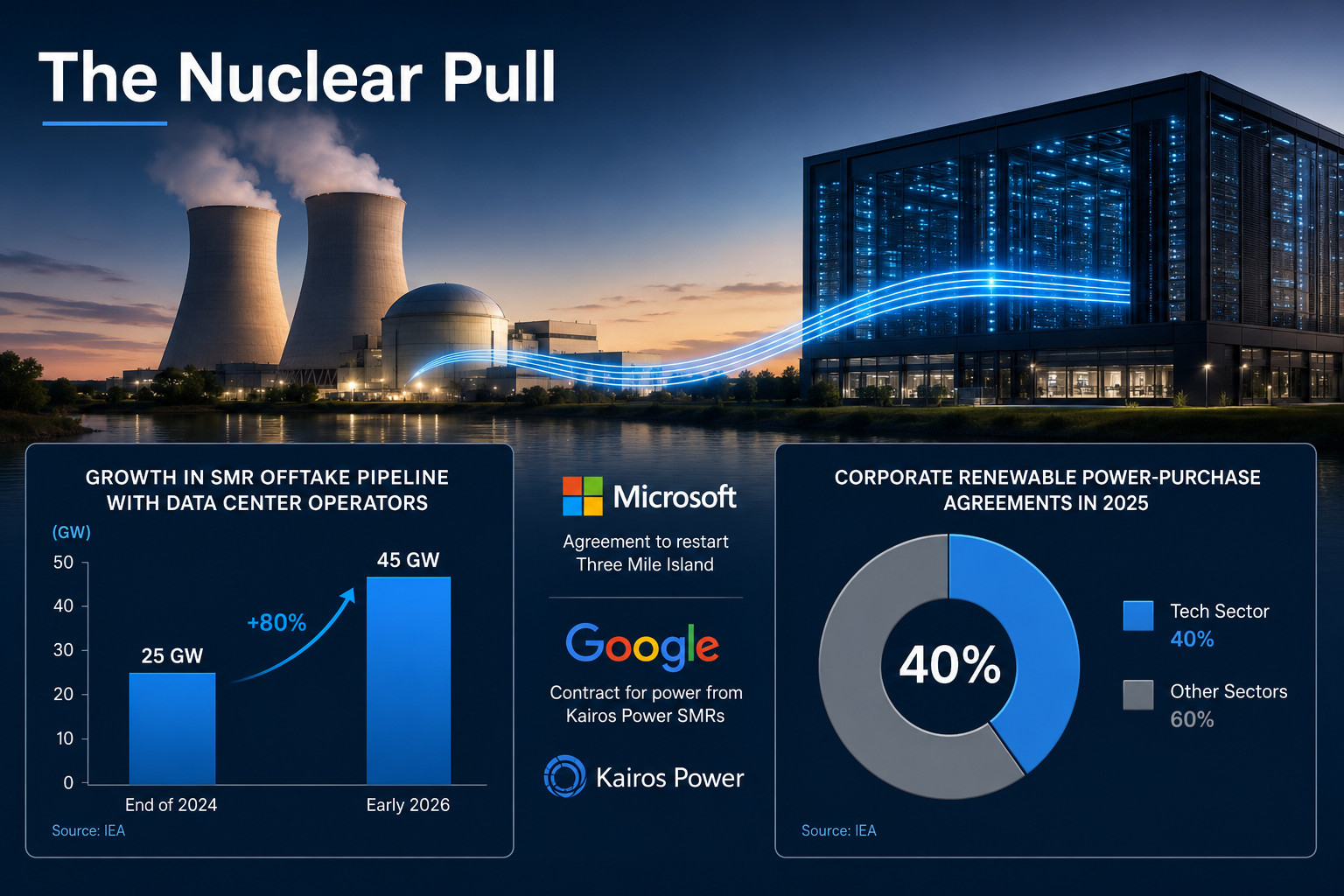
The most striking second-order effect is what AI demand is doing to nuclear power. Tech companies want firm, carbon-free, 24/7 electricity, and that has made them a major source of momentum for advanced nuclear.
The pipeline of conditional offtake agreements between data-center operators and small modular reactor (SMR) projects grew from 25 GW at the end of 2024 to 45 GW by early 2026 (IEA). High-profile deals — Microsoft's agreement tied to restarting Three Mile Island, Google's contract for power from Kairos Power's SMRs — signal a structural shift, not a one-off (Global Electricity). The tech sector also accounted for roughly 40% of all corporate renewable power-purchase agreements signed in 2025.
Reduce Downtime & Radiation Exposure - Optimize Nuclear Inspections with ROVs
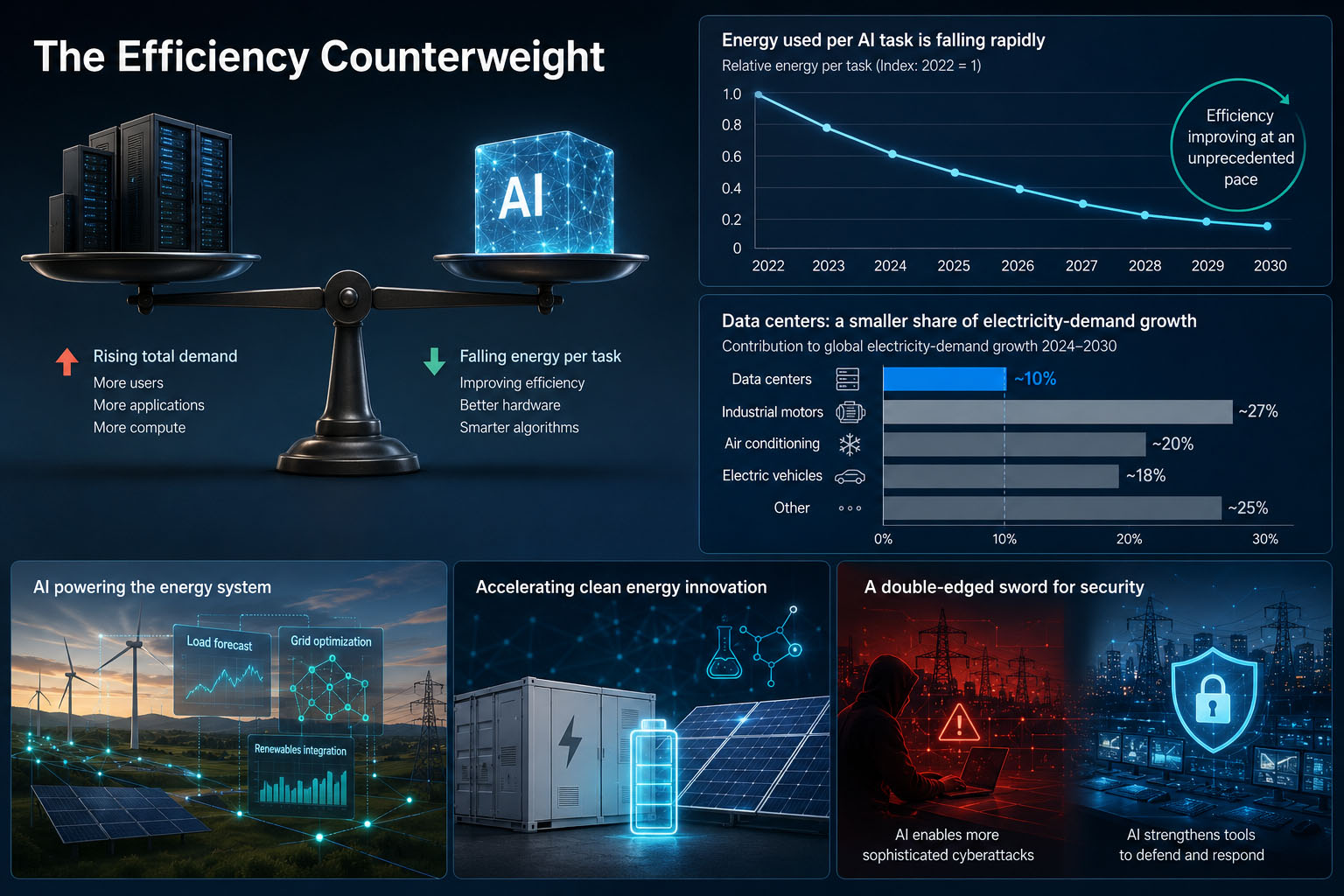
It isn't purely a story of runaway consumption. The energy used per AI task is falling rapidly, with efficiency improving at a pace the IEA describes as unprecedented in energy history (IEA, Key Questions on Energy and AI). The catch is that more people are using AI, and energy-intensive applications like autonomous agents are growing — so total demand keeps rising even as each individual operation gets cheaper to run.
It's also worth keeping the scale in perspective: even at the projected 2030 level, data centers account for only about one-tenth of global electricity-demand growth this decade — less than the growth from industrial motors, air conditioning, or electric vehicles (IEA, Energy and AI). The strain is real but concentrated in specific grids, not uniform across the system.
And AI is increasingly turned back on the energy system itself, improving load forecasting, grid optimization, and the integration of variable renewables, while also accelerating research into core clean-energy technologies like batteries and solar PV. It cuts both ways on security, too: AI enables more sophisticated cyberattacks on utility infrastructure even as it strengthens the tools utilities use to defend against them.
Meeting this demand means building and maintaining a lot of physical plant — new reactors, gas capacity, and the cooling-water systems that large data centers and power stations both depend on. Those cooling intakes, tanks, and pipelines need regular inspection to run reliably, and much of that work happens underwater or in confined spaces where keeping systems online matters most. Remote inspection tools play a quiet but real role here, helping keep the power and cooling infrastructure behind AI running without costly downtime. For the broader picture of which sources will carry this load, see our guide to the energy sources of the future.
| Category | Details |
|---|---|
| Current demand (2025) | Data centers consumed about 485 TWh of electricity — roughly 1.5% of global use1 |
| 2030 projection | Roughly doubles to ~950 TWh (~3% of global demand) — comparable to Japan's total electricity use today; rising to ~1,200 TWh by 20351,2 |
| AI-specific growth | Electricity use by AI-focused data centers set to triple by 2030; overall data-center demand growing ~15% a year, more than four times faster than other sectors1,2 |
| Geographic concentration | The US and China account for ~80% of global growth; US data centers drive nearly half of US demand growth, and by 2030 will use more electricity than all US energy-intensive manufacturing combined2 |
| Meeting the demand | Renewables and natural gas lead the supply; ~15–27 GW of onsite gas and ~20–25 GW of battery storage may serve data centers by 2030, with the first SMRs online around 20301,2 |
| Investment | Combined capital spending by the five largest tech firms passed $400 billion in 2025 and is set to rise ~75% in 2026, driven largely by data centers1 |
| In perspective | Despite the surge, data centers account for only about one-tenth of global electricity-demand growth to 2030 — less than industrial motors, air conditioning, or electric vehicles2 |
Sources: 1 IEA, Key Questions on Energy and AI (2026) — iea.org. 2 IEA, Energy and AI special report (2025) — iea.org.
Need Help Choosing What ROV is Best for Your Application? Here is Our Comprehensive ROV Buyer’s Guide to Help You Identify the Right Model.
Below, we answer common questions:
How Much Electricity Do Data Centers Actually Use?
About 485 TWh in 2025, roughly 1.5% of global electricity, projected to reach around 950 TWh by 2030 and roughly 1,200 TWh by 2035. The 2030 figure is comparable to the total electricity consumption of Japan today. For perspective, even at that level data centers account for only about one-tenth of global electricity-demand growth this decade, less than the growth from industrial motors, air conditioning, or electric vehicles. The strain is real but concentrated in specific grids rather than spread evenly.
How Much Water Do Data Centers Use?
Accelerating AI adoption alone could add 4.2 to 6.6 billion cubic meters of water withdrawal a year by 2027, counting both onsite server cooling and the electricity generation behind it. That is four to six times Denmark's annual use. Water and power are the same constraint viewed from two angles, which is why data-center siting increasingly turns on access to both. See our guide to water security and modern desalination.
What Is Driving the Surge in Data Center Electricity Demand?
The rapid expansion of AI — particularly large language models, AI inference, and autonomous agents — requires enormous amounts of computing power, which runs on electricity 24 hours a day. Combined with cloud computing growth and the digitization of more industries, data-center electricity demand jumped 17% in a single year in 2025 and is on track to double by 2030.
Why Are Tech Companies Turning to Nuclear Power for Data Centers?
AI infrastructure needs firm, carbon-free, around-the-clock power — something solar and wind alone can't reliably provide. Nuclear, and SMRs in particular, deliver exactly that. The pipeline of offtake agreements between data-center operators and SMR projects grew from 25 GW to 45 GW in just over a year, and major deals like Microsoft's Three Mile Island agreement and Google's Kairos Power contract signal a structural shift in how tech companies source power.
Why Is Data Center Power Demand Concentrated in Certain Areas?
Data centers cluster near fiber infrastructure, cheap land, and available grid connections — which is why Northern Virginia alone draws more than 5 GW. That concentration means the grid strain from AI demand is a local and regional problem as much as a global one, with specific markets like the US mid-Atlantic, Texas, and parts of Europe seeing much sharper pressure than the averages suggest.
Will AI's Efficiency Gains Offset Its Growing Energy Demand?
Partially, but not enough to reverse the trend. The energy needed per AI task is falling at a historically unprecedented rate, but the number of tasks being run is growing faster still. More users, more applications, and more energy-intensive workloads like autonomous agents mean total demand keeps rising even as individual operations become cheaper to run.
Does AI Help the Energy System as Well as Strain It?
Yes — AI is increasingly used to improve load forecasting, optimize grid operations, integrate variable renewables, and accelerate research into batteries and solar PV. It also strengthens cybersecurity defenses for utility infrastructure, though it simultaneously enables more sophisticated attacks. The long-term sustainability of AI's energy demand may partly depend on how effectively AI itself is used to make the grid smarter and more efficient.
What Keeps Data Center Power and Cooling Infrastructure Running?
Cooling intakes, storage tanks, and pipelines at both data centers and the power stations supplying them need regular inspection to run reliably, and much of that work happens underwater or in confined spaces. Remotely operated vehicles and crawlers inspect these systems without draining them or taking capacity offline, which matters most when the load they support runs around the clock and unplanned downtime is expensive.
Request a Quote: Ready to explore Deep Trekker solutions for your operations? Contact us for a customized quote.

March 17th, 2026
Two-day AIMS training program teaches SAR teams how to integrate sonar...

March 11th, 2026
Deep Trekker’s SPECTRA ROV integrates 3D Sonar SLAM, 4K stereo vision,...

November 3rd, 2025
At REPMUS 2025, Deep Trekker’s ROVs validated real-world mine countermeasure capabilities...